Khamis, 26 September 2013

BLOG - BLOG PARTI PKR

BLOG - BLOG PARTI PKR


www.telokkemang.blogspot.com/

Posted: 26 Sep 2013 07:25 AM PDT

www.telokkemang.blogspot.com/


CERAMAH KELOMPOK SUNGGALA-LINGGI - 9 JUN

Posted: 10 Jun 2012 11:42 PM PDT

Rakyat hadir memberikan sokongan kepada Pakatan Rakyat-KEADILAN. Siri Penerangan telah dibuat oleh AMK N9 dan juga bersama Pejabat Parlimen Telok Kemang. Saya ucapkan tahniah kepada semua yang hadir dan ucapan terima kasih buat semua yang telah membantu menjayakan program termasuk AMK N9.

Pihak UMNO/BN tidak mampu memjawab isu yang kita bangkitkan termasuk isu penurunan harga minyak dan pendidikan percuma, maka mereka menyebarkan gambar lucah untuk tatapan rakyat. Politik nilai adalah politik berasaskan fakta dan bukannya fitnah. Marilah kita bersama memastikan kemenangan rakyat melalui Pakatan Rakyat menjelang PRU-13 akan datang. Salam perjuangan buat semua.

-Kamarul Baharin Abbas-
MP Telok Kemang


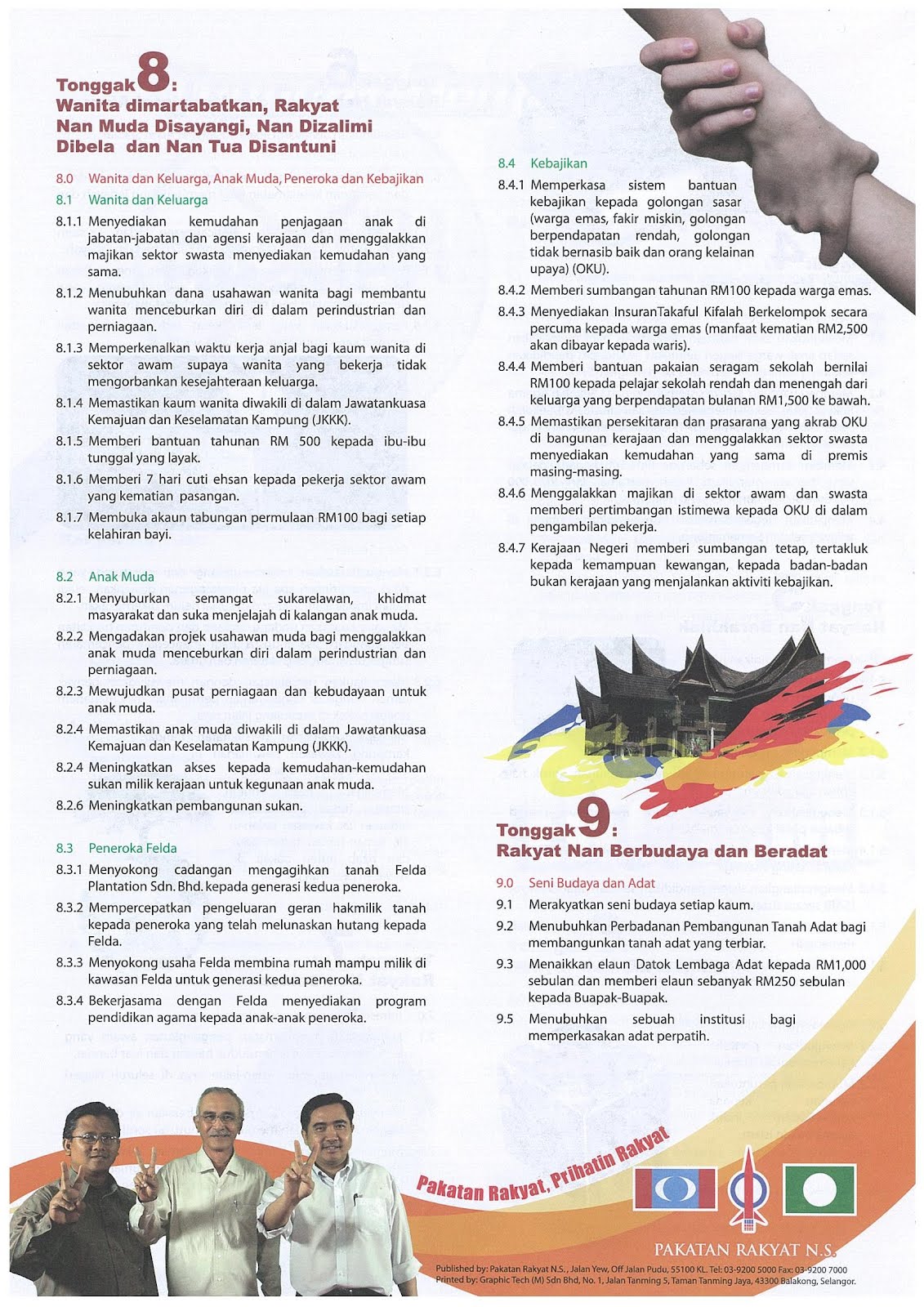
Manifesto Pakatan Rakyat N. Sembilan - Sisipan rujukan buat rakyat

Posted: 03 Jun 2012 10:11 PM PDT

Ini adalah Manifesto Pakatan Rakyat N. Sembilan - Tonggak Nan Sembilan yang disepakati oleh Pakatan Rakyat N. Sembilan. Ayuh bersama kita lakukan perubahan Demi N. Sembilan tercinta.


Anwar Ibrahim

Posted: 25 Sep 2013 07:16 PM PDT

Anwar Ibrahim


The End of Poverty, Soon

Posted: 25 Sep 2013 02:37 AM PDT

The New York Times

Appealing for peace 50 years ago, President John F. Kennedy told the Irish Parliament, "The problems of the world cannot possibly be solved by skeptics or cynics, whose horizons are limited by the obvious realities. We need men who can dream of things that never were and ask, why not?"

Today, more and more people are dreaming of a world free of poverty.

In April, the Development Committee of the World Bank set the goal of ending extreme poverty by the year 2030. More recently, the United Nations General Assembly working group on global goals concluded that "eradicating poverty in a generation is an ambitious but feasible goal." As one who wrote in 2005 that ours was the generation that could end extreme poverty, I am pleased to see this idea take hold at the highest levels.

Are these errant dreams as the world barrels toward more confusion, conflict and climate change, or is there something substantial in the recent wave of high-level interest in the idea? The evidence is on the side of the optimists. And the evidence also supports both those who favor more markets and those who favor more public-private strategies. It's all a matter of context.

The global picture will surprise doomsayers. According to the World Bank's scorecard, the proportion of households in developing countries below the extreme-poverty line (now measured as $1.25 per person per day at international prices) has declined sharply, from 52 percent in 1980, to 43 percent in 1990, 34 percent in 1999, and 21 percent in 2010. Even sub-Saharan Africa, the region with the most recalcitrant poverty, is finally experiencing a notable decline, from 58 percent in 1999 to 49 percent in 2010.

The gains are more marked in health. According to the latest Unicef study this month, the mortality rate of children under 5 in Africa declined from 177 deaths per 1,000 births in 1990, to 155 per 1,000 births in 2000, to 98 per 1,000 in 2012. This is still too high, but the rate of progress is rapid and accelerating.

While the recent gains are undoubted, the question is how to ensure that progress on incomes, health and other dimensions of poverty eradication (including access to schooling, safe water, electricity, sewerage) continues until extreme poverty is vanquished. Debates rage on this question and often shed more heat than light.

Here are the basics: economic growth, and hence a market economy, is vital. Africa's poverty is declining in part because its growth rate picked up from 2.3 percent per year during the lackluster years of 1990-2000 to 5.7 percent during 2000-10. Without economic growth, there cannot be sustained gains in income, health and other areas. Continued progress depends on heavy investments in major infrastructure — water, electricity, waste management — and these in turn depend on large-scale private financing, hence a suitable market framework.

So anti-market sentiment is no friend of poverty reduction. But neither is free-market fundamentalism. Economic growth and poverty reduction can't be achieved by free markets alone. Disease control, public education, the promotion of new science and technology, and protection of the natural environment are public functions that must align with private market forces.

Consider two keys to Africa's recent poverty reduction. The first is the introduction of cellphones, which have revolutionized communication and much else in both remote African villages and the streets of Manhattan. Smartphones are poised to transform education, health care, finance and agricultural value chains. Malaria control, made possible by new technologies, including long-lasting bed nets, rapid diagnostic tests and a new generation of medicines, has also played a vital role in reducing poverty in Africa.

In both cases, the private sector has been essential, not only in developing breakthrough technologies but also enabling them to spread in a short time. Hundreds of millions of cellphones and hundreds of millions of bed nets have helped slash rural poverty in the past few years.

Yet the public sector is also critical. Public funds finance crucial scientific and technological breakthroughs. The Global Fund to Fight AIDS, TB and Malaria, an agency backed by international public funds, has financed the mass distribution of the bed nets. Malaria is down by at least 30 percent as a result. Smartphone applications for community health workers are now similarly being hugely scaled up with increased public as well as private backing.

One can say that the fight to end poverty is helping to forge a new kind of mixed capitalism. Old debates of public versus private are being superseded by new strategies that involve both the public and private sectors. The need for both will become more urgent asclimate change and water scarcity intensify. Also, the idea of bold global goals' driving bold actions is proving the cynics wrong. A global commitment to ending extreme poverty will spur creativity and action.

As Kennedy also declared a half-century ago, "By defining our goal more clearly — by making it seem more manageable and less remote — we can help all people to see it, to draw hope from it, and to move irresistibly toward it."

KPRU: Pola Pengurusan Kewangan Najib Membawa Risiko Tidak Menentu Kepada Negara

Posted: 25 Sep 2013 01:39 AM PDT

KPRU

Berikutan pembentangan satu lagi belanjawan tambahan oleh kerajaan pusat di bawah pentadbiran Perdana Menteri Datuk Seri Najib Tun Razak, badan pemikir Kajian Politik untuk Perubahan (KPRU) berpendapat, pola pengurusan kewangan negara oleh Najib semenjak beliau menerajui Kementerian Kewangan memaparkan sikap yang tidak berhemat dalam tadbir urus kewangan negara.

Sepanjang pentadbiran Najib, pola pengurusan kewangan negara menyaksikan pembentangan dua belanjawan tambahan secara konsisten berikutan setiap pembentangan belanjawan asal negara. Pembentangan belanjawan tambahan bukanlah sesuatu yang ganjil dalam sistem pengurusan kewangan negara. Namun begitu, dalam konteks kewangan negara berada dalam defisit fiskal sepanjang pentadbiran Najib, pembentangan dua belanjawan tambahan secara konsisten bagi setiap belanjawan asal menonjolkan suatu sikap tadbir urus kewangan negara yang tidak berhemat.

Merujuk kepada Jadual KPRU di bawah, bekas Perdana Menteri Tun Abdullah Ahmad Badawi telah membentangkan Belanjawan Negara 2009 pada 29 Ogos 2008. Seterusnya Najib memegang tampuk pentadbiran negara dan membentangkan Belanjawan Negara 2010, 2011, 2012 dan 2013. Dalam pada itu, Najib juga membentangkan belanjawan tambahan bagi menampung perbelanjaan negara bagi tahun 2009, 2010, 2011, 2012 dan 2013.

Jadual KPRU: Belanjawan Asal dan Perbekalan Tambahan 2009 – 2013 (RM Juta)

Tahun Belanjawan Asal Perbekalan Tambahan Jumlah
Pertama Kedua Jumlah
2009 207,899 10,000 11,360 21,360 229,259
2010 191,499 12,077 15,218 27,295 218,794
2011 213,987 13,187 10,290 23,477 237,464
2012 232,833 15,295 12,707 28,002 260,835
2013 251,667 15,014 - 15,014 266,681

Hak cipta © KPRU 2013

Sumber: Akta Perbekalan dan Akta Perbekalan Tambahan bagi tahun 2009, 2010, 2011, 2012 dan 2013.


KPRU berpendapat, dalam keadaan di mana kewangan negara berada dalam status lebihan (surplus), pembentangan belanjawan tambahan dapat dilihat sebagai sebahagian daripada alat pengurusan kewangan negara yang mempunyai fungsinya yang berkait rapat dengan belanjawan tahunan. Namun, dalam konteks kewangan negara berada dalam status defisit selama enam belas tahun berturut-turut, pembentangan dua belanjawan tambahan secara konsisten dapat dilihat sebagai sebahagian daripada pola pengurusan kewangan negara yang membawa risiko tidak menentu berhubung masa depan kewangan negara.

Umum kini sedia maklum, pada 31 Julai 2013, agensi penilaian global, Fitch Ratings telah menilai unjuran kredit Malaysia dan menyemak semula prospek Malaysia daripada status "stabil" ke "negatif" berikutan kelemahan kewangan awam selepas Pilihan Raya Umum ke-13 dan juga kekurangan kemajuan dalam reformasi kerajaan dalam usaha menangani defisit fiskal. Fitch dengan nyatanya menunjukkan bahawa hutang kerajaan telah mencecah 53.3% dalam Keluaran Dalam Negari Kasar (KDNK) penghujung 2012 daripada 51.6% pada hujung 2011 dan 39.8% pada hujung 2008.

Dalam sebuah laporan bertarikh 17 September 2013, Bank of America Merrill Lynch berpendapat, hutang kerajaan Malaysia berkemungkinan besar mencecah silingnya iaitu 55% daripada KDNK. Laporan tersebut menyatakan bahawa, hutang kerajaan Malaysia telah meningkat kepada 53.8% pada penggal pertama 2013, seterusnya meningkat kepada 54.6% daripada KDNK pada penggal kedua 2013.

Malahan, apabila diambil kira tanggungan luar jangka (contingent liabilities), iaitu sebanyak RM147.3 bilion pada penggal kedua 2013, hutang kerajaan meningkat kepada 70.2%!

Berikutan pembentangan belanjawan tambahan kedua bagi tahun 2012 semasa sesi parlimen Jun 2013 dan pembentangan belanjawan tambahan pertama bagi tahun 2013 pada sesi ini, KPRU berpendapat, hampir pasti Najib akan membentangkan belanjawan tambahan kedua bagi tahun 2013 pada sesi parlimen tahun depan. Kini pembentangan dua belanjawan tambahan menjadi "peristiwa tahunan" selepas pembentangan belanjawan tahunan negara pada setiap hujung tahun. Hal ini bermaksud, angka defisit yang dibekalkan semasa pembentangan belanjawan tahunan lebih bersifat sementara sedangkan pengiraan nilai dan kadar defisit selepas pembentangan belanjawan tambahan lebih bermakna dalam memahami kerangka pengurusan kewangan negara.

Dalam konteks tersebut, berdasarkan anggaran asal Kementerian Kewangan semasa membentangkan Belanjawan Negara 2013, pengiraan KPRU di bawah mendapati bahawa defisit fiskal tahun 2013 akan mencecah 5.5% daripada KDNK setelah mengambil kira belanjawan tambahan pertama bagi tahun 2013, iaitu 1.5% lebih tinggi daripada unjuran asal sebanyak 4.0%


Statistik Kerajaan: Kedudukan Kewangan Kerajaan Persekutuan 2013 (RM Juta)[1]

Anggaran Asal 2013 (Unjuran)
Hasil 208,650
Perbelanjaan Mengurus 201,917
Perbelanjaan Pembangunan Bersih 46,726
Defisit/Lebihan Semasa -39,993
% daripada KNK -4.1
% daripada KDNK -4.0
KNK (harga semasa) 980,889
KDNK (harga semasa) 1,001,794


Statistik KPRU: Unjuran Defisit Fiskal Pasca Perbekalan Tambahan 2013 (2013) (RM juta)

Perbelanjaan Mengurus 201,917
Perbelanjaan Pembangunan Bersih 46,726
Perbekalan Tambahan Pertama 2013 Perbelanjaan Tanggungan 888
Perbelanjaan Bekalan 14,126
Jumlah Perbelanjaan 263,657
Defisit/Lebihan Keseluruhan -55,007
% daripada KNK -5.6%
% daripada KDNK -5.5%

Hak cipta © KPRU 2013

CORNERED, Umno man admits Jakarta has not approved PKR turncoat Zahrain for envoy post

Posted: 25 Sep 2013 01:36 AM PDT

Malaysia-Chronicle

After trying to fob off the Opposition with ambiguous replies – even when in Parliament – Deputy Foreign Minister Hamzah Zainuddin has finally admitted that PKR turncoat Zahrain Hashim has not been approved by the Indonesian government although proposed by Malaysia as its new ambassador to Jakarta.

The rebuff, if confirmed, would be a serious slap in the face not only for Zahrain but also for Prime Minister Najib Razak, who has been accused of handing out top government posts as rewards for political favors even if the beneficiaries were not suitably qualified or the practice was unfair depriving more deserving choices from the civil service.

“How can we name him when we have not received a reply from Indonesia? Although we have appointed him and he has gone through due process including having an audience with the Yang di-Pertuan Agong, we still need Indonesia’s go-ahead. Otherwise they might question why we named him without waiting for their response,” Hamzah told reporters on Tuesday.

‘They did not ask’ but why did Hamzah “laboriously avoided” naming Zahrain

The deputy minister then tried to up the ante against the Opposition lawmakers who had yet yesterday baited and caught him red-handed trying to lie over the issue.

“They don’t know what is happening, yet they want to comment. They just want to paint a bad picture of the government,’ Hamzah said.

“I was not being evasive, furthermore, they did not ask about Zahrain’s status inside the House, so how to answer when they did not ask.”

Foreign Minister Aniah Aman had on September 5 announced Zahrain’s appointment. However, till now, the Indonesian side has not given the green light.

Unprofessional Najib: ‘You help me, I help you’

The questioned posed by PAS MP Mahfuz Omar to the government was who were the ambassadors or top attache’s who had been picked from the political field.

Mahfuz had posed this question amid public grousing that Prime Minister Najib Razak was not being objective in selecting only the best and most suitable candidates to fill up top diplomatic posts.

Such grousing is not uncommon and actually reflects poorly on the BN’s track record but Zahrain was catalyst for the latest bout of unhappiness, especially amongst those in the civil service who believe they were better qualified for the post.

Many accused Najib of behaving unprofessionally by appointing Zahrain to the plum job. They saw it as a reward to Zahrain for pulling out of Opposition Leader Anwar Ibrahim’s PKR party in 2010 so as to embarrass the latter and weaken his party.

At that time, Zahrain was accused of having received a multi-million ringgit payout and left for a two-week holiday to London with his family immediately after announcing his resignation from PKR.

Saving face for Najib

According to Mahfuz, the Malaysian PM must select ambassadors with the greatest care as this was an important post which buttress Malaysia’s growth.

“We need people with brains. This is not just a ceremonial role and about drinking tea and eating cake,” said Mahfuz.

On Tuesday, Hamzah had named 4 ambassadors including former Inspector-General of Police Ismail Omar to France and former PPP vice-president Blanche O’Leary to Finland, but he “laboriously avoided” mentioning Zahrain.

“I can only think of 3 reasons why. The appointment has not been been carried out. Or has the appointment been cancelled? Or has the Indonesian president not approved the appointment?” Mahfuz’s PAS colleague, Hatta Ramli, the MP for Kuala Krai had said.

Some bloggers have also suggested Hamzah was trying to ‘save face’ for Najib, as the delay in approving Zahrain’s appointment also showed Anwar’s influence in Indonesia, where he is popular and known among the masses as a reformist.


Is The Ban On The Muslim Brotherhood The Revolution’s End?

Posted: 25 Sep 2013 12:36 AM PDT

The New Yorker

There have been many moments in recent weeks that ought to have ended the debate over whether Egypt's military staged a coup against the country's struggling revolution, or somehow resuscitated it, when it deposed the elected President, Mohamed Morsi, in early July—so many that one can be forgiven for losing count. But if any doubt remained, it was removed conclusively on Monday, when a court formally banned the Muslim Brotherhood, which had stood behind Morsi, from public life.

The ruling was breathtaking in scope: it applied not only to the Brotherhood's political wings but to its social-services activities, and even to any personal declarations of membership individuals might be brazen enough to make—all were declared illegal. The intent was clear: to cast out the Brotherhood from any future role, not just in politics but in Egyptian society altogether. "The plan is to drain the sources of funding, break the joints of the group, and dismantle the podiums from which they deliver their message," an Egyptian official told the Associated Press.

But if the future of a democratic Egypt is bleak, it is not simply because of sweeping court rulings like Monday's. Indeed, the question that consumed Egypt for much of July and August —was it a coup?— was always the wrong one. Of course it was a coup. The real question is whether any of the lofty aims of the revolution (the dreams of a popular, democratic government, with civilian control of the military, and a thriving free press), or even the more basic ones (an end to wanton police abuses and outright political corruption) still stand a chance amid the backlash.

In answering that question, the focus on the intentions and orders of Egypt's generals and judges inevitably misses the point. Like the initial uprising itself, the survival of Egypt's revolutionary goals ultimately depends not on decisions from the top but the endurance of those at the bottom. It was these people, the ones with nothing to lose from standing up to Hosni Mubarak's police, who swelled the streets around Tahrir Square in early 2011, facing barrages of tear gas, rubber bullets, and the condemnation of everyone from politicians to their parents. They tended their wounds in field hospitals inside the square, and entertained themselves late into the night with concerts and speeches, grabbing sleep when they could on cheap blankets and under makeshift tents on the muddy ground. By the time the urban elite and moneyed classes joined in the revolution, bringing a critical mass and inescapable legitimacy to the uprising, the original legions had been squatting in the square for ten days.

The problem is that now these young and disenfranchised people have largely turned away from the revolution, too. Two and a half years of grueling politics left very few of them with the sense that anything had been accomplished, through all the tear gas and sleepless nights, other than perhaps the construction of new rhetoric from the elite and a crummier economy. The Brotherhood shares some of the blame for this. Ruling with majoritarian fervor, and without regard for popular dissent, its leaders spent much of their time in office transplanting the edifice of their organization into the halls of official power—bypassing the many who'd demanded a fresh start, and transparency, for Egypt's government.

But then, there is plenty of fault to go around. The young political figures who arose from Tahrir's revolutionary youth councils in the weeks and months after Mubarak's fall devoted far too much energy to squabbling and petty infighting. Their failure to coalesce around one or even two political leaders meant that none of their candidates stood much of a chance in the parliamentary—let alone the presidential—elections. The vote that put the Brotherhood's Morsi in power was a choice, in the end, between him and Ahmed Shafik, a former prime minister in Mubarak's government. In the two years after free elections arrived in Egypt, the voiceless majority still had no one in a position of real prominence to articulate its message.

When I travelled to Egypt in August, I visited a friend named Mohammed Magdy whom I first got to know during the early days in Tahrir Square. Magdy was in his mid-twenties when we met, an underemployed, secular Muslim from a middle-class household just around the corner from Tahrir. He's made occasional appearances in my reporting over the years, offering a counterbalance to the detached rhetoric of Cairo's absent elite or its urgently tweeting university-educated class.

At first, Magdy had been a source of buoyant optimism, and perpetual energy: by night, he'd join in the clashes against Mubarak's thugs; by day, he spirited around Tahrir jotting down any jokes he heard. (It's worth remembering how much humor there was at the start of Egypt's uprising.) Later, as the uninspiring politics of the post-Mubarak era dragged on, I watched as Magdy soured on the process; he joined in the street clashes against the interim military government in the fall of 2011, but with lessening enthusiasm. When it came time to vote in the first parliamentary elections, I wasn't surprised to hear, a few days beforehand, that he had no idea who he would vote for—or even who the candidates in his district were.

But I'd never seen him as disaffected as I did in August. We sat at a cafe in a narrow street behind Tahrir, one of the places of quiet reprieve we used to retreat to during the revolution, when the clamor or tear gas grew to be too much. As he sipped a glass of hot tea with milk and smoked a Cleopatra-brand cigarette (noxious, but cheap), he spoke energetically about his family and his new job constructing a restaurant with some friends from school. But he said nothing at all about politics, until I brought it up. Then he shrugged. "My two enemies are fighting each other," he said finally, meaning the military and the Brotherhood. "There is nothing for me in this." He went back to talking about the restaurant.

To keep the spirit of Tahrir Square alive, people like Magdy have to be willing to keep on fighting, even when the situation looks hopeless. When you've lost them, is the revolution over?

Dr Mahathir: Lepaskan kuasa, elak Umno dipenuhi “orang bodoh”

Posted: 24 Sep 2013 09:42 PM PDT

TMI

Tun Dr Mahathir Mohamad (gambar) menasihati pemimpin Umno supaya tidak memegang kuasa terlalu lama bagi mengelakkan parti Melayu terbesar itu dipenuhi dengan lebih ramai "orang bodoh".

Bekas Perdana Menteri paling lama berkhidmat itu berkata, seseorang pemimpin perlu mengetahui had masanya semasa berkuasa.

“Pemimpin perlu tahu hadnya, jangan terlalu lama memegang kuasa.

 ”Sebaliknya akan berlaku, kamu (parti) akan mempunyai lebih ramai orang bodoh dalam parti,” kata Dr Mahathir dalam satu majlis di International Youth Centre (IYC) hari ini.

Beliau berkata, pemimpin Umno perlu bersikap terbuka untuk menerima mereka yang lebih bijak daripada mereka untuk menjadi pemimpin, bukannya mengamalkan sikap suka mencantas.

“Pemimpin yang teruk adalah apabila mereka menyekat pemimpin yang lebih pandai kerana takut tergugat,” katanya.

Rabu, 25 September 2013

BLOG - BLOG PARTI UMNO

BLOG - BLOG PARTI UMNO


HAMIM Ledang

Posted: 25 Sep 2013 03:03 AM PDT

HAMIM Ledang


Bersama Penduduk-Penduduk Kampung Sialang, Tangkak

Posted: 19 Sep 2013 08:08 PM PDT


20 September 2013
3.00 ptg

Warung Seri Mayang, Sialang Dalam

Razlan's

Posted: 24 Sep 2013 11:13 PM PDT

Razlan's


Anak Muda akan terus dibela penggal 2013-2016

Posted: 24 Sep 2013 08:48 PM PDT

Ucapan Terima Kasih 

Assalamualaikum

Pertamanya, saya mengucapkan ribuan terima kasih kepada semua yang telah menyokong saya  dan senantiasa memberi dorongan kepada Jawatan Kuasa Pemuda Bahagian.
   
Pada tahun ini, Pergerakan Pemuda UMNO Bahagian Seputeh mencipta sejarah apabila semua jawatan di peringkat Pemuda Bahagian di isi kembali tanpa dipertandingkan.

Berkat daripada usaha dan kerja keras seluruh Jawatan Kuasa yang di ketuai oleh Saudara Badrul Ezan selaku Naib Ketua Pemuda, hasilnya dapat di lihat oleh semua peringkat. Tanpa semangat yang IKHLAS bekerja untuk parti, ianya mustahil dapat di terjemahkan dengan keputusan permilihan kali ini.

Kami berterima kasih kepada Kepimpinan Bahagian yang diketuai oleh Ybhg Datuk Mustapa Kamal selaku Ketua UMNO Bahagian dibantu oleh Datuk A Rahim Aman dan Datuk Mariam Minhat dan Jawatankuasa Bahagian yang tidak pernah jemu dan senantiasa memberikan kepercayaan kepada kami untuk melaksanakan program sehingga segala tanggunjawab dapat disempurnakan dengan baik.

Pemuda UMNO Bahagian Seputeh telah memperjuangkan soal Perumahan dan ianya telah dijadikan dasar Kerajaan, ianya di ilhamkan kerana melihat orang Melayu Bandar dipinggirkan oleh sistem ekonomi yang tidak berpihak kepada Orang Melayu. Oleh itu, Perjuangan kali ini akan diteruskan bagi kepentingan Agama, Bangsa dan Negara untuk orang Melayu di pertahankan sebaik mungkin.

Saya suka mencadangkan agar kita meneruskan desakan kepada Kerajaan, kita sebagai Pemuda Bandar merupakan golongan yang terancam secara sistematik ekoran dari pembanggunan ekonomi disekeliling kita, oleh itu, kita lah yang perlu mengetuai bagi mempertahankan hak-hak kita di negara tercinta ini.


Hidup Melayu, Hidup UMNO.
Memasyarakatkan pemuda agenda kita!


Mohd Razlan Bin Muhammad Rafii
Ketua Pemuda UMNO Bahagian Seputeh

demi agama bangsa dan negara

Posted: 24 Sep 2013 01:03 PM PDT

demi agama bangsa dan negara


Pemilihan UMNO penggal 2013 - 2016

Posted: 23 Sep 2013 11:40 PM PDT

Semangat BERSATU MEMPERKASAKAN PEMUDA utk bersama2 memberikan khidmat kpd institusi UMNO. Mohon sokongan dan undian para perwakilan seluruh negara.


Pentas UMNO Kg.Serdang, Sitiawan. Perak

Posted: 24 Sep 2013 01:02 PM PDT

Pentas UMNO Kg.Serdang, Sitiawan. Perak


Kerajaan Bimbang Tahap Polarisasi Semaking Teruk - Tan Sri Muhyiddin Yassin!

Posted: 24 Sep 2013 06:00 AM PDT


Kerajaan gusar dengan trend terkini dalam masyarakat terutama dalam konteks hubungan antara kaum yang dilihat mempunyai kecenderungan untuk menimbulkan isu polarisasi.

Timbalan Perdana Menteri Tan Sri Muhyiddin Yassin, berkata kelompok masyarakat hari ini lebih mudah sensitif sehinggakan usaha baik yang dirancang kerajaan dipandang serong.

Beliau menambah, initiatif kerajaan kadangkala bukan sahaja dianggap negatif dikalangan rakyat malah ianya turut dijadikan isu yang menyentuh perkauman seperti apa yang berlaku terhadap Pelan Induk Pembangunan Pendidikan 2013-2025 (PIPP).

"Perhimpunan konvensyen yang dibuat oleh Dong Zhong semalam dikatakan telah membuat resolusi untuk menghalang apa yang kerajaan buat dalam PIPP dimana ia dibentuk untuk memajukan sektor pendidikan.

"PIPP, kita rancang dengan niat yang baik, namun ia dipandang serong sesetengah pihak yang melihat usaha ini berbaur perkauman.

"Selama 13 tahun pelaksanaan PIPP, ia tetap dilihat sebagai usaha menghapuskan bahasa ibunda mereka," katanya ketika berucap pada Majlis Berbuka Puasa dan Penyerahan Pelatih Amanjaya Internship di kediaman rasmi Menteri Besar Datuk Dr Zambry Abdul Kadir di sini.

Muhyiddin menambah, Dong Zhong melihat niat baik kerajaan itu sebagai sentimen perkauman walaupun telah kerajaan mengambil masa hampir dua tahun untuk mengumpul input PIPP agar ia sejajar dengan Akta Pendidikan serta Falsafah Pendidkan Negara.

Beliau yang juga Menteri Pendidikan berkata trend itu langsung tidak membantu kerajaan dalam memupuk semangat perpaduan dalam kalangan semua kaum.

Dalam pada itu, beliau turut menyeru umat Islam supaya mementingkan perpaduan, hubungan mesra serta persefahaman berikutan sentiasa berdepan cabaran hebat.

"Dalam suasana begini, masyarakat Islam perlu kukuhkan jemaah. Berikutan ada pihak yang anggapan bahawa masyarakat Islam tidak kukuh disebabkan wujudnya pelbagai puak Melayu, lantas ramai yang lantang sehingga berani mempersoalkan hak-hak dalam Perlembagaan, agama dan raja," katanya.

Pada majlis itu, Muhyiddin turut menyampaikan sumbangan berupa kurma, air zam-zam, kain pelikat dan jubah kepada pengerusi dan anggota jawatankuasa masjid daerah dari seluruh negeri.

Selepas berbuka puasa, beliau dan Zambry, Pengerusi Tabung Haji Datuk Abdul Azeez Abdul Rahim, exco kerajaan negeri serta umat Islam menunaikan solat Maghrib, Isyak serta tarawih berjemaah yang diimamkan guru Al-Quran Masjidil Haram, Makkah, Sheikh Osama Mohammad Iqbal.

Warna-warni politik
Torashah

Selasa, 24 September 2013

BLOG - BLOG PARTI PKR

BLOG - BLOG PARTI PKR


MEDIA Rakyat MALAYSIA

Posted: 24 Sep 2013 03:36 AM PDT

MEDIA Rakyat MALAYSIA


SEROJA BANTU POLIS CEGAH JENAYAH

Posted: 23 Sep 2013 10:48 AM PDT

DUGAAN IBLIS SEBELUM MENEMPUH SKARATUL MAUY ~ UAI

Posted: 23 Sep 2013 08:36 AM PDT

Anwar Ibrahim

Posted: 23 Sep 2013 07:20 PM PDT

Anwar Ibrahim


Najib-Muhyiddin re-elected without contest CONFIRMS Umno’s political bankruptcy – PR

Posted: 22 Sep 2013 11:17 PM PDT

Malaysia-Chronicle

he unopposed contests of Datuk Seri Najib Razak and Tan Sri Muhyiddin Yassin in Umno's top two posts despite Barisan Nasional's (BN) disastrous Election 2013 results, shows the party's lack of credible leaders, Pakatan Rakyat (PR) leaders said today.

PKR vice-president N. Surendran pointed out that under Najib's leadership, BN had recorded its worst-ever electoral performance in the recent May 5 polls, where it failed to win the coveted two-thirds parliamentary majority and lost the popular vote for the first time since 1969, when it was the Alliance then.

"That despite his poor showing, Najib is re-elected is a sign of Umno's bankruptcy as a political force," Surendran said.

"They did worse in this election and are steadily heading towards GE defeat. But Umno is desperate; they have no one better and can't afford the massive blood-letting of a presidential contest," added the Padang Serai MP.

Najib and Muhyiddin returned unopposed as Umno's president and deputy president yesterday in the party elections.

Malaysia's prime minister and deputy prime minister are typically the top two leaders in BN's mainstay party.

PAS central committee member Dr Dzulkefly Ahmad said today that the absence of a challenge against the top two posts in Umno spelled doom for the dominant Malay party.

"Najib failed on both passing marks on the two-thirds majority and winning back Selangor," Dzulkefly said.

"Despite all those, there's none in the party that is willing enough to come out and give a strong reprimand over his failures…The challenge is meant to convey a very strong message that you are not indispensable and you must be accountable for your failures," he added.

Dzulkefly also stressed that although Umno had increased its federal seat tally from 79 to 88 in the 13th general election, BN's performance as a whole needed to be taken into account.

"They can't go round bragging they won nine more seats. The question is, at what price? You have to put that in perspective," said the PAS research centre director.

"The effect of killing your comrades, your partners…there's only Umno left in BN," added Dzulkefly.

MCA had suffered a crushing defeat in Election 2013 by winning just seven federal and 11 state seats, leading the main Chinese party in BN to refuse government posts.

DAP strategist Liew Chin Tong said that no one in Umno dared to challenge Najib and Muhyiddin as the duo had the power of incumbency.

"No one has the numbers. The electoral system favours the incumbent. There's no taker because they don't see they're going to win," Liew said.

AND THE MURDERERS ARE Najib & Umno: Race-based policies are killing the economy

Posted: 22 Sep 2013 11:16 PM PDT

Malaysia-Chronicle

Over the last two days, the death of a very young girl in an apparent suicide bid by a family of four has captured the attention of the nation. The story which was front-paged by a daily English newspaper for two days in a row, if anything, is perhaps a glaring and stark indication of the state-of-the-nation now.

Initial investigations by the authorities show that the family was facing a financial struggle. They lived in a shop-house in Taman Sri Sentosa, off Old Kland Road, Kuala Lumpur and made several attempts to end their lives. The couple and a son survived the attempts but their little girl succumbed to death.

Their horrifying decision to kill themselves came about after the father, a contractor, failed to obtain a loan of RM30,000 to do business and the mother was unsuccessful in a bid to become a kindergarten teacher.

They were reduced to living on pittance and the shame and misery was just too much for them to bear that they made the drastic decision to commit suicide together as they felt there was no more point in living.

This is Malaysia now in the real New Millennium where the doors are beginning to close on people and families and this story is starting to cause Malaysians to wonder if there are other such tragedies waiting to happen, if this is the tip of the iceberg.

How really do Chinese and Indians figure?

We are well accustomed to hear tales of the Indian community whereby many languish in Malaysian jails as gangsters for crime and why the number of Indians who are assessed as mentally unstable rising in numbers.

Are the Chinese and Indians now in such despair and despondency that there is no way out or manner of affirmative action in place by the Barisan Nasional (BN) Government for these communities? They have been long neglected by the implementation of The New Economic Policy from 1970 and which ran for a 30-year period only to be replaced by the New Economic Model.

Are Chinese and Indians not citizens of this country that are on par or equal footing with the bumiputras? Must they be at the mercy of banks, insurance companies, money lenders and loan sharks for financial assistance while the bumiputras are given a guaranteed safety net by the Malaysian Government?

In what is seen as a complete reversal and betrayal of Najib's "Satu Malaysia" concept, just prior to Malaysia Day, the BN government announced a slew of initiatives in a grand, affirmative action plan exclusively for bumiputras.

This was to thank the bumiputras for supporting the government and standing by BN in the 13

GE which was a clear slap in the face by Najib for the Chinese and Indians who went out on a limb to support Pakatan Rakyat.

This immature move by the BN government which continues to reek of their lop-sided justice in practicing partisan politics has sparked outrage and inflamed the fires of race relations as this is a sheer case of racism being practiced against the minority races.

The Bumiputra Economic Empowerment Agenda

The agenda as outlined by the Malaysian government focuses on five main thrusts:

> Empowering bumiputra human capital.

> Strengthening bumiputra equity ownership in the corporate sector

> Strengthening bumiputra non-financial asset ownership

> Improving bumiputra entrepreneurship and businesses; and

> Strengthening the services delivery ecosystem

This slew of initiatives will also cause a 10 billion unit injection into a New Amanah Saham Bumiputra 2, expand PSD and Mara post-graduate programmes to increase highly-qualified bumiputras, give an additional RM1 billion loan or "freebie" to bumiputra entrepreneurs and the CEOs of Government-Linked Companies to have Key Performance Indicators on bumiputra participation and a bumiputra development unit is to be set up within every ministry.

The questions non-bumis are beginning to ask

In the light of this new agenda which will supersede the New Economic Model, non-bumi's are beginning to ask when affirmative action for the bumiputras will come to a close. The bigger question on their mind is why since 1970 non-bumis have been separated from bumiputras and hardly been given any kind of affirmative action.

The kind of affirmative action that could have spared the death of a little Chinese girl whose hopes to live a meaningful live was actually snuffed out by an apathetic and indifferent government in power. Not only her but the numerous other non-bumi's who are the casualties of Malaysia's weakening economy.

By failing to practice meritocracy and by opting for partisan politics and showing favoritism to the bumiputra community for such a long period of time is really to the degradation of the country and it is high time the spotlight of the international community begin to focus on Malaysia and the atrocities practiced by the BN regime.

Non-bumi's are being unfairly overlooked and the plight of even those non-bumi's who are well off are beginning to start to weaken as the BN government turns to skewer the economy in favor of the bumiputras only.

There is little hope and there is little left for the non-bumis when the economic pie is being chopped nearly wholly to be given to the bumiputras on a silver platter. Indians such as those belonging to Hindraf must now be wondering why on earth they supported BN in the first place.

If truth was a casualty of the 13th GE, then the truth of the matter is that Malaysians of all walks of life including those from PKR and Parti Pas and DAP have been hoodwinked by BN-Umno. They have pulled the rug from under the feet of Malaysians.

What about the future?

Malaysia is now a country that is beginning to be taken note of by the international community. The BN-UMNO leadership has come to the forefront of world attention owing to their refusal to toe the line of globalization.

While the whole wide world is becoming increasingly globalized, it appears that Malaysia is starting to become like a fish out of water and all calls by the global community requesting Malaysia to practice the full tenets and obligations of democracy have so far fallen on deaf years. It's like pouring water on a duck's back.

Despite the peril, Malaysia still wants to go ahead and be stubborn and defiant in wanting to see that the country is governed not democratically, but by the whims and fancies of the UMNO big-wigs. When will Malays start to realize that UMNO is not leading them along a healthy path but instead beginning to ostracize and isolate the Malays.

By spewing out affirmative action only for the benefit of bumiputras, UMNO has begun to paint itself into a corner. It will be hard in future for the Malay to gain respect and acceptance on merit among Malaysians and on the global stage owing to much favoritism that has been shown to them.

Whatever the Malays and other bumiputras achieved will then be considered a hollow achievement, something which does not carry merit as it goes to show that it was actually not achieved through a level but lop-sided playing field in which bumiputras were basically being handed success to them without any effort.

This really means that all that affirmative action has actually caused bumiputras to weaken and heavily dependent on the government with the government continuing to bail them out to stay in power. This is a vicious cycle that is causing bumiputras to get nowhere in life and exasperating to non-bumis.

Election Commission took orders from Putrajaya, Ambiga tells Bersih tribunal

Posted: 22 Sep 2013 11:12 PM PDT

TMI

Bersih co-chair Datuk Ambiga Sreenevasan said the Election Commission (EC) acted under the instructions of Putrajaya when it should have acted as an independent body.

Ambiga, who was the last witness at the Bersih People's Tribunal in Subang Jaya, stressed that the EC had taken a partisan approach when making statements.

"EC acted like they were under Putrajaya's control. I have problems with the commission for their failure in giving proper explanations on the issues surrounding the electoral roll and others under their purview," she said today.

She added that the commission would not say anything when election-related issues cropped up.

"They failed to fulfil their responsibilities to investigate political violence and other serious allegations during GE13," said Ambiga.

She told the tribunal the EC's sole responsibility was election matters. "If they have not got it right, it just shows their lack of empowerment," said Ambiga.

"It's like their hands were tied."

Among the issues brought to the tribunal's attention was how the electoral roll did not tally with the data kept by the National Registration Department, the indelible ink, and phantom voters as well as postal voters.

Ambiga said the EC had failed Malaysians on the indelible ink issue.

"They cannot do this and give wishy-washy answers. They are just letting it fade away and hope everybody will forget all about it.

"Many questions were not answered. This is not right.

"EC should be the one advising the government, not following their orders," said Ambiga.

She said the EC should be independent as it managed the selection process that decided which party would form the next government.

The attitude of the EC leadership, like its deputy chairman Datuk Wan Ahmad Wan Omar, was also raised as he was seen to be always criticising the opposition.

One of the tribunal's members, Professor Madya Dr Mavis Puthucheary, later said the tribunal should focus on how to improve the EC structure instead of only looking at the weaknesses of its members.

"Our role here is not to criticise the EC but to improve the system. Maybe their hands were really tied legally," said the former Universiti Malaya Faculty of Economics and Administration associate professor.

The tribunal started on September 18 and ended today.

Ambiga also stated it would be difficult to remove the EC members as they were appointed by the King.

Ambiga testified to a packed room. Among other witnesses today was former Kuala Selangor MP Dr Dzulkefly Ahmad. Also seen there was Bersih co-chair Datuk A Samad Said.

Malaysia’s PM Capitulates to the Hardliners

Posted: 22 Sep 2013 08:52 PM PDT

Asia Sentinel

The Sept.14 announcement of an array of new economic benefits for ethnic Malays by Malaysian Prime Minister Najib Tun Razak represents the premier’s final post-election capitulation to radical Malay nationalists in the United Malays National Organization.

The new plan signifies a U-turn back to the New Economic Policy of affirmative action for ethnic Malays that was put in place in 1971 following disastrous 1969 race riots. Economists are largely in agreement that the policy has saddled the economy for three decades. Najib, an economist himself, has been attempting to undo the policy for three years through his 1Malaysia economic liberalization program. The new plan will play a major role in UMNO’s deliberations at its Oct. 5 annual general assembly and is key to Najib’s keeping his job, UMNO insiders say. If nothing else, it is recognition that reform inside the party is dead.

The prime minister has been largely powerless against Malay supremacist forces led by former Prime Minister Mahathir Mohamad since the May elections, in which the opposition shocked the ruling Barisan Nasional by winning the popular vote, 50.27 percent to 47.38 percent, with the remainder going to splinter parties. The Barisan kept its hold on parliament, 133-89, because of extensive gerrymandering and malapportionment of parliamentary districts.

Mahathir and the forces aligned with him blame Najib for the Barisan’s poor showing because of his attempt to reach out to multi-ethnic voters instead of putting all of his resources into inciting the Malay base to capture all potential of Malays, who comprise 60.1 percent of the population. The Barisan captured only about 60 percent of the ethnic Malay vote, taking a drubbing from ethnic Chinese and Indians.

The ensuing insistence on revenge has demonstrated the ruling coalition’s slippery hold on the concept of democracy, with UMNO cadres demanding that opposition voters be punished for what was regarded as their disloyalty rather than a recognition that corruption, cronyism, rent-seeking, favoritism and growing fear of the Malay supremacists had played a bigger role.

Since the election, the weakened Najib has largely had to bend to the wishes of the Malay supremacists despite the fact that the most virulent of the Melayu Ketuanan (Malays first) candidates, Ibrahim Ali, Zulkifli Noordin and Puad Zarkashi of the NGO Perkasa, were rejected by the voters in constituencies in which there were strong Malay majorities.

The demand to punish opposition voters first resulted in a July decision to cut the allocation of public university seats for Chinese students to 19 percent down from 23 percent last year, in line with their representation in the overall population. Indians, who make up about 8 percent of the population, were awarded only 4 percent of the university seats. The rest went to bumiputeras.

The other shoe dropped Saturday when Najib held his widely anticipated press conference to announce the package of new perks in government and finance for ethnic Malays. Najib, also the country’s finance minister, said the focus areas would include enhancing bumi equity ownership in the corporate sector as well as asset ownership, according to the prime minister’s website.

“The government heard the cries for help from the bumiputeras regarding their level of participation in socio-economic development programs,” he said. Targets will be set for quotas for the chief executive officers of government-linked companies (GLCs), including for projects awarded to vendors. To enhance bumiputera equity ownership in the corporate sector, government investment funds will assist bumi-owned companies to be listed on Bursa Malaysia. Other measures will aid bumis in ownership of homes, industrial premises and commercial complexes.

These policies, or ones very much like them, resulted in unqualified ethnic Malays being handed executive positions in GLCs including the state-owned airline, a state-owned construction company and others only to either run them into the ground or to loot them of hundreds of millions of ringgit.

It has also resulted in so-called Ali-Baba companies, in which Alis — ethnic Malays — for decades have been given executive posts in companies run by Babas, the nickname for Straits-born Chinese, creating a relatively wealthy class of ethnic Malays who have lived off their positions without learning the businesses or doing much real work; they are treated with disdain and irritation by the executives who make the real decisions. Most economists feel the NEP hobbled the economy, encouraged rent-seeking and enriched a handful of well-placed cronies at the top of the party.

In all, for foreign and domestic investors, this largely signals a dispiriting return to policies that Najib had sought to erase, but which met the virulent opposition of the ketuanan Melayu crowd. Those policies can be expected to put more roadblocks in the way of a dynamic economy, probably permanently crimping Najib’s goal of pulling the country out of the so-called middle income trap in which it has been mired for more than a decade.

It is expected to discourage both foreign and domestic investment and spur both capital flight and immigration by qualified ethnic minorities seeking advancement elsewhere. Already, according to a World Bank study, at least 1 million Malaysians live permanently overseas.

Najib’s announcement of the policy takes place against the backdrop of a worsening racial situation, which the respected news portal Malaysia Insider, in an editorial last Friday, said has never before “been this bad, this widespread, this debilitating and potentially irreversible for Malaysia.”

Since the election, the drumbeat of racial hatred, fanned by the Malay-language broadsheet Utusan Melayu, which is wholly owned by UMNO and can be considered its mouthpiece, has grown ever more powerful, with ethnic Indians and Chinese, particularly Christians, coming under withering criticism.

It can only be expected to get worse in October when the UMNO annual general assembly gets underway. The conclave has always featured strident calls for emasculating the political and economic power of the Chinese and has always portrayed ethnic Malays as economic and political victims done out of their rightful place in a country where other races are interlopers.

Najib, initially thought to be in danger of losing his job as premier, as Abdullah Ahmad Badawi had done before him, is expected to survive the AGM as both UMNO president and prime minister, sources in UMNO say, partly because there is nobody who is either ready or wants the job, and partly because Najib is now wholly a captive of the Mahathir wing of the party.

The wild card is that this year for the first time, because of party changes engineered by Najib, all 160,000 UMNO rank and file will vote for the top positions in the party. Prior to this year, the voting was confined to top cadres from each of the party’s districts, representing the larger numbers. This time, the party will learn for the first time how deep the resentment runs against the losses the party underwent in the 2013 general election.

BULETIN RAKYAT

Posted: 23 Sep 2013 11:31 AM PDT

BULETIN RAKYAT


SEKIM KESELAMATAN KEJIRANAN PANGSAPURI (SEROJA) BANTU POLIS PELIHARA KESELAMATAN DAN CEGAH JENAYAH

Posted: 23 Sep 2013 10:47 AM PDT

BATU CAVES, 23 SEPT: Sebanyak 5 pangsapuri dipilih menjadi perintis Skim Keselamatan Kejiranan Pangsapuri (SEROJA) yang dirumus bagi membantu polis memelihara keamanan dan mencegah jenayah di kawasan-kawasan pangsapuri seluruh Selangor.

Exco Perumahan, Pengurusan Bangunan dan Peneroka Bandar Iskandar Abdul Samad berkata Skim Seroja ini disasar membantu sehingga 250 pangsapuri di masa akan datang.

Dijangka dilaksanakan Oktober tahun ini, lima pangsapuri itu adalah Laksamana Jaya, Seri Era, Puchong Permai, Mawar Cempaka dan Megah Villa. Penduduk yang dipilih untuk melakukan rondaan pengamanan di pangsapuri masing-masing akan disaring Polis Diraja Malaysia terlebih dahulu, dan dilengkapi dengan belantan, wisel dan lampu suluh.

"Kerajaan negeri akan membantu program bantu mula ini selama tempoh 3 tahun dan selepas itu program ini dapat diteruskan oleh penduduk itu sendiri.

"Pihak kerajaan negeri juga berterima kasih kepada pihak polis yang bersedia untuk memberikan kerjasama sepenuhnya bagi memastikan program berjaya dilaksanakan," kata Iskandar di program pelancaran Skim Seroja di Pangsapuri Laksamana Jaya, 21 September lepas.

Acara dihadiri oleh Ketua Polis Daerah Gombak, ACP Abdul Rahim Abdullah dan Yang Dipertua Majlis Perbandaran Selayang, Mohd Azizi Mohd Zain dan Adun Batu Caves, Amiruddin Shari.

Kerajaan Negeri memperuntukkan RM10,000 setahun untuk mengadakan program-program keselamatan dibawah SEROJA. Peronda yang terlibat juga diinsuranskan sehingga RM10,200 sekiranya berlaku kemalangan semasa melakukan rondaan.

HADIAH IPT DI NAIKKAN KE RM3000 DI SELANGOR

Posted: 23 Sep 2013 09:53 AM PDT

SUBANG JAYA 23 SEPT : Sempena Belanjawan Selangor 2014, Kerajaan Negeri akan menaikkan had kelayakan Hadiah Anak Masuk Universiti daripada pendapatan seisi rumah RM1,500 sebulan kepada RM3,000 sebulan.
Menteri Besar Tan Sri Abdul Khalid Ibrahim berkata kedudukan kewangan negeri yang kukuh membolehkan pemerkasaan program-program pro-rakyat seperti ini.
"Kita mampu meningkatkan insentif ini berikutan rezab negeri yang semakin bertambah sehingga mencecah hampir RM3 bilion," katanya dalam majlis perasmian Majlis Dialog Belanjawan 2014 di Hotel Grand Dorsett Subang Jaya.
Skim ini merupakan salah-satu daripada program pro-rakyat dibawah agenda Merakyatkan Ekonomi Selangor (MES).
Hadiah RM1,000 diberi kepada anak Selangor dari keluarga berpendapatan RM1,500 ke bawah, untuk memudahkan mereka melanjutkan pendidikan ke pusat pengajian tinggi awam/swasta yang diiktiraf kerajaan dengan mengikuti pengajian peringkat diploma atau ijazah sarjana muda.
Setakat ini, jumlah direkodkan mencatatkan lebih RM35.7 juta dibelanjakan dengan kira-kira 35,722 peserta mendapat manfaat dari program Hadiah Anak Masuk Universiti itu.
"Sambutan kepada program ini amat membanggakan dan ia ternyata membawa manfaat besar kepada rakyat Selangor," tegas beliau.